How to Trade Opciones Binarias with the Vortex Indicator and a Moving Average
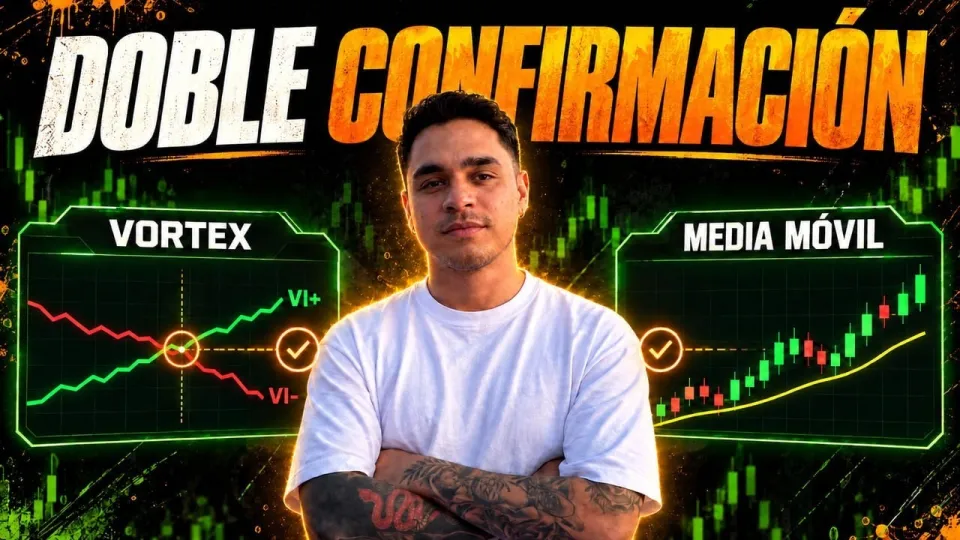
Video: Opciones Binarias! Vortex y media móvil — cuándo entrar y cuándo!
· based on the channel Trader Loco 📈
Key takeaways
- The Vortex indicator has two lines, VI+ and VI−; a cross between them marks a possible shift in momentum direction.
- A moving average acts as the confirmation filter: a Vortex signal is only taken when price sits on the correct side of the MA.
- Flat or sideways markets are the main source of false Vortex crosses, so range conditions should be skipped entirely.
- Signals that appear without MA confirmation are discarded — no trade is better than a forced trade.
- The setup works on short intraday timeframes, including the 1-minute chart used in the Trader Loco 📈 breakdown.
Opciones binarias are short-term binary options trades where you predict whether an asset will close above or below the strike price at expiry; one of the cleanest ways to time such trades is to combine the Vortex indicator with a moving average, taking a signal only when a Vortex line cross is confirmed by price position relative to the MA. The Vortex shows when momentum flips direction, and the moving average filters out the crosses that happen inside a range. A free trading bot for testing this setup is available via the Trader Loco bot link.
What the Vortex indicator actually measures
The Vortex indicator is a two-line momentum tool: VI+ tracks upward directional movement and VI− tracks downward movement, and the relationship between the two lines describes who currently controls the price. When VI+ pushes above VI−, upward momentum is building; when VI− crosses above VI+, sellers are taking over. Because the calculation is based on the distance between the current high/low and the previous bar's extreme values, Vortex reacts quickly — which is exactly what short-expiry binary options need, and also why it produces so many false crosses in quiet markets. The indicator does not measure trend strength the way ADX does and it does not define support or resistance; it only answers one question: which side has the directional edge right now.
How to read Vortex crosses correctly
A Vortex cross is a warning, not an entry — it tells you momentum may be shifting, and the trade only becomes valid once a second condition agrees. In practice the reading works like this:
- Watch for VI+ to cross above VI− (bullish bias) or VI− to cross above VI+ (bearish bias).
- Check how far apart the lines are: a wide, clean separation after the cross is stronger than two lines tangled together.
- Ignore crosses where the lines keep flipping back and forth within a few bars — that is chop, not a signal.
- Treat the cross as valid only for the next few candles; a Vortex signal that appeared five bars ago has already lost most of its edge for a short expiry.
Using the moving average as the confirmation filter
The moving average is what separates a tradeable Vortex signal from noise: longs are only taken when price is above the MA, shorts only when price is below it. This single rule removes most counter-trend entries, because a bullish Vortex cross that happens under a falling moving average is usually just a pullback inside a downtrend. Traders typically use a short-period MA on intraday charts so the filter does not lag too far behind price, and the MA slope matters as much as its position — a flat MA is a warning that the market has no direction. When the Vortex cross and the MA agree, you have a trend-following setup; when they disagree, you have a reason to wait.
When to stay out of the market
Sideways markets are where most binary options accounts bleed, because Vortex crosses fire repeatedly without any follow-through. The practical filter is simple: if the moving average is flat and price is chopping around it, skip every signal regardless of what the Vortex lines do. A range is easy to recognise — repeated touches of the same highs and lows, candles overlapping each other, no clear sequence of higher highs or lower lows. In that environment the indicator is measuring noise, and the probability of a correct short-term prediction drops close to a coin flip while the payout still works against you. Waiting is a position: no entry costs nothing, while a forced entry in a flat market costs the stake.
Step-by-step entry checklist
A repeatable checklist keeps the strategy mechanical instead of emotional. Before clicking buy or sell on a binary option, run through these conditions in order:
- Confirm the market is trending — the moving average is sloping, not flat.
- Confirm price is on the correct side of the MA for the direction you want.
- Wait for a fresh Vortex cross in that same direction; do not chase an old one.
- Check that the two Vortex lines are separating, not tangled.
- Choose an expiry that matches the timeframe you are reading — a signal from a 1-minute chart does not justify a one-hour expiry.
- Skip the trade if any condition fails; the next setup is always coming.
Signals that fail the checklist should be written off immediately rather than "monitored" — tracking rejected setups is how traders talk themselves into bad entries.
Managing the trade after entry
Once the option is placed, the outcome is fixed at expiry, so trade management happens before entry, not after. Position size should be small enough that a losing streak of several trades does not change your decision-making, and the number of setups taken per session should be capped so one choppy hour cannot wipe out a good day. Because binary options pay a fixed percentage on winning trades, the required win rate is higher than 50% — a typical payout in the region of 60–80% means you need roughly 55–62% accuracy just to break even, which is why filtering matters more than signal frequency. Keeping a simple log of which checklist conditions were present on each trade quickly shows whether the Vortex-plus-MA filter is actually improving your results.
Common questions from traders testing this setup
Most doubts around this combination come down to signal frequency and patience. Traders who switch to the Vortex and moving average method often complain that valid setups are rare — that is the point, since the filter exists to remove trades, not create them. Others ask whether the bot can run the strategy automatically: automation tools can execute the rules, but the rules still have to be defined and tested first, and no bot turns a range-bound market into a trending one. A third recurring theme is the 1-minute chart — it produces many crosses per session, but most of them fail the MA confirmation, so the effective number of trades is far lower than it first appears. Finally, traders ask how to handle a signal that appears right at the MA: when price is sitting on the line, there is no confirmation either way, so the correct action is to wait for a clear close above or below.
Useful links
- Free trading bot from Trader Loco
- Live strategies and signals channel
- Registration with the promo code «LOCO» for a +60% bonus
Final thoughts
The Vortex-plus-moving-average combination is a filtering framework rather than a signal generator: the Vortex cross proposes a direction, and the MA decides whether that direction is worth risking money on. Applied strictly, it removes most of the trades a beginner would otherwise take — especially in sideways markets, where binary options payouts punish coin-flip accuracy. The discipline of discarding unconfirmed signals is the real edge, and it costs nothing to practise on a demo account or through the free bot before committing real stakes. This breakdown of the setup comes from the Trader Loco 📈 channel, which walks through when to enter and when to wait; you can start with the free bot at https://t.me/loco_trader_bot?start=yt_26_1710 and test the rules on your own charts.
Source: Opciones Binarias! Vortex y media móvil — cuándo entrar y cuándo! · Markdown version
Questions & answers
Do I need both the Vortex indicator and a moving average to trade binary options?
The Vortex alone produces too many crosses during quiet periods, so a moving average is used as a trend filter. Longs are taken only above the MA and shorts only below it, which removes most counter-trend and range-bound signals. If you only have one tool, the Vortex cross without confirmation is not a complete setup.
Which timeframe works best for this Vortex and MA strategy?
The combination is designed for short intraday expiries, including 1-minute charts, because Vortex reacts quickly to momentum shifts. The expiry you choose should match the timeframe you are reading, so a 1-minute signal does not justify a long expiry. Longer timeframes produce fewer but cleaner crosses.
How many valid signals should I expect per session?
Far fewer than the raw number of Vortex crosses suggests, since most crosses fail the moving average confirmation or occur in a flat market. On a 1-minute chart you may see dozens of crosses but only a handful of tradeable setups. Treating that low frequency as normal is what keeps the filter effective.
Can a trading bot run this strategy automatically?
A bot can execute defined rules consistently and remove hesitation, but it cannot invent an edge for you. The Vortex and MA conditions need to be specified and tested first, including how to handle price sitting directly on the moving average. Automation is best used after the rules have been validated manually.